
MISSILES & GUNS

Plate 1. Mk 8 4.5-inch gun
At night on 5 June 1982, HMS Cardiff (D108) conducted gunfire support against Argentine positions on the Falkland Islands. The image shows the gun in the resting position just after dawn the next day. She had fired 277 4.5-inch rounds Photograph by Kenneth lan Griffiths.

Plate 3. Mk 8 4.5-inch gun (results of)
Short SC.7 Skyvan (PA-54) transport aircraft destroyed at Stanley racetrack. It belonged to the Argentine Coast Guard (Prefectura Naval Argentina) and was destroyed by British naval 4.5-inch gunfire. The photograph is attributed to Pete Oxford.
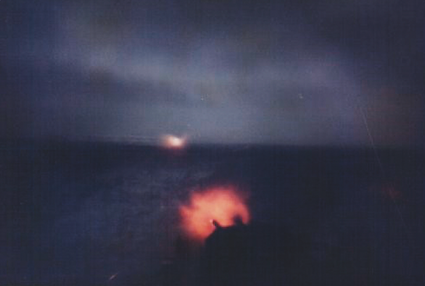
Plate 2. Mk 8 4.5-inch guns
HMS Glamorgan’s forward, twin 4.5-inch guns firing at Pebble Island on 14-15 May during an SAS raid. The SAS focussed on destroying aircraft, while Glamorgan’s guns targeted fuel supplies. Photograph taken by Petty Officer Andy Gatherer (electronics warfare officer, Royal Navy).

Plate 4. Roland SAM (French design)
Argentine Roland SAM system from the 601st Air Defence Artillery Group. This Roland system shot down a Sea Harrier (XZ456) on 1 June 1982. The photographer may have been Eduardo A. Rotondo. Picture sourced from a Facebook post by Agustin Vazquez.

Plate 5. Sea Dart SAM
An image of HMS Exeter firing a Sea Dart missile at a Learjet on 7 June 1982. All five crew on the Learjet were killed. Photographed by Laurence Brown, Royal Navy.

Plate 6. Sea Dart SAM
The Type-42 destroyer HMS Edinburgh firing a Sea Dart missile in 2012. The fore and aft domes for the 909 guidance radars are evident. Photographer, LA(Phot) Dave Jenkins, Royal Navy. Wikimedia Commons.

Plate 7. Sea Dart SAM
Air beathing Sea Dart missile at IWM Duxford, UK, 2015. Note the four antennas around the air intake at the nose, which make up the interferometer array that helps guide the missile to a target. Photographed by M.R. Ibbotson.

Plate 8. Sea Wolf & Sea Dart SAMs
Missiles at IWM Duxford, UK, 2015. Both missiles proved highly effective during the war. Photographed by M.R. Ibbotson.

Plate 9. GWS-25 launcher for Sea Wolf, as used in 1982
Sextuple launcher firing a Sea Wolf missile in April 2009 from a Type-22 frigate, HMS Cornwall. Crown copyright. Open Government Licence (OGL) v3.0.

Plate 10. Rapier SAM
A Rapier missile fired in the Falklands. On obtaining it, the photograph had been partially ‘colorised’. Photoshop was used by MR Ibbotson to improve the colorisation. The heat-haze is real. Tim Mander / Alamy Stock Photo.
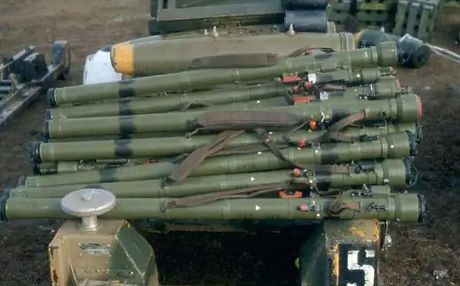
Plate 11. SA-7 SAM
9K32 Strela-2 (SA-7 Grail) surface-to-air missiles provided by Libya to Argentina during the Falklands War. These were captured after the war by the British. Photographed by Tim Rees.

Plate 12. FIM-92 Stinger
This readily available photograph purports to show an SAS trooper firing a FIM-92 Stinger missile in the Falklands. The SAS shot down a Pucará and a Puma helicopter using this weapon, which was obtained discretely from US special forces. I was unable to identify the photographer. The image has been attributed to Crown Copyright in some sources.
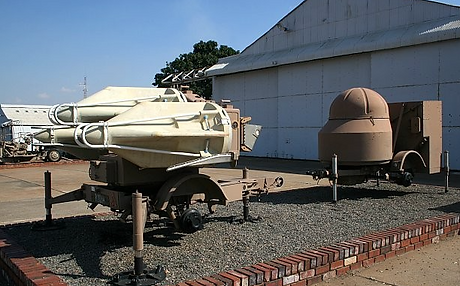
Plate 13. Tigercat SAM
Tigercat launch trailer with three covered missiles. The control system is shown behind, looking like a water tank. All trailers are missing their wheels. This system was operated in South Africa. Photograph by Dean Wingrin. Picture sourced from the SAAF website.

Plate 14. Tigercat SAM
A view over Stanley soon after the Falklands War, with recent snowfall. A triple Tigercat launch trailer is shown with two missiles covered by grey protective shrouds. Two uncovered missiles are discarded in the snow, painted white, with yellow fins. Crown copyright IWM FKD 2843.

Plate 15. Tigercat SAM at Yorkshire Air Museum 2026
This launcher and the associated director were captured by 63 Sqn RAF regiment in June 1982. Subsequently re-painted in British colours. Photograph by M.R. Ibbotson.

Plate 16. Control panel for Tigercat
The control status panel for the Tigercat in Spanish. Photograph by M.R. Ibbotson.

Plate 17. Monitoring panel for Tigercat
Monitoring system for launch in Spanish. Photograph by M.R. Ibbotson.
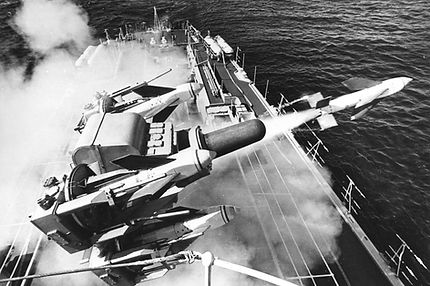
Plate 19. A Seacat missile being fired
Plate 24 in book. Seacat missiles from which the Tigercat was derived. Basically the same missile with a different land-based launch system. (Chronicle/Alamy Stock Photo)

Plate 21. Wessex with SS.11
An early Wessex HAS.1 helicopter (XM330) in 1962 carrying SS.11 missiles. During the Falklands War, a Wessex HU5 fired two closely related AS.12 missiles at an Argentine HQ (at the police station in Stanley). I couldn't find a high-resolution picture of Wessex with AS.12. Crown copyright.

Plate 18. Testing point at rear of Tigercat
Spanish plate saying Platform [test bed] No. 1. Testing points. Photograph by M.R. Ibbotson.

Plate 20. Scout AH.1 with SS.11s
Plate 21 in book, showing a Scout helicopter carrying SS.11 wire guided anti-tank missiles. The Seacat (Plate 19) was developed using some of the technology developed for the SS.11. Wikimedia Commons: Share Alike 4.0 International License.

Plate 22. AS.12 mounted on a Wasp helicopter
This Wasp helicopter (XT434) is carrying AS.12 missiles, as used in this configuration against the Argentine submarine, Santa Fe. The AS.12 is longer and has a bulbous nose compared to its predecessor, the SS.11. It had more explosive force, so it could be used as an anti-ship missile. Crown copyright.

Plate 23. Bofors 40mm
This Bofors 40mm gun is shown on HMS Intrepid, with a sailor loading the four-shell clip manually from above. Crown copyright.

Plate 25. Blowpipe SAM
Argentine troops with a British-made Blowpipe SAM in the Falklands. This weapon-type is known as a MANPADS (man portable air defence system). Photographer not reported.

Plate 24. Seacat or Bofors 40mm?
Lt Lucero landing in a parachute after ejecting from his A-4 on 25 May 1982. He was rescued and given excellent medical care on HMS Fearless. He was shot down by a combination of Seacat and 40mm Bofors. The exact cause of the shoot down remains disputed. The photographer is thought to have been Sub Lieutenant Clive Pickering (some reports suggest Roy Gillingham).

Plate 26. Blowpipe SAM
Photograph of Argentine troops taken from an RAF Harrier GR3. The man on the left has a Blowpipe SAM and is lifting it onto his shoulder to fire. This photograph caused great alarm when revealed to the Harrier pilots that flew the mission! The image was photographed by me from Martin Middlebrooks book - The fight for the 'Malvinas'.

Plate 27. Blowpipe SAM
A member of the Argentine army’s 601 Commando Company at Port Howard on West Falkland aiming his Blowpipe missile at Lieutenant Jeff Glover’s Harrier GR3 (1 (F) Squadron, RAF). The Harrier was shot down and Glover landed in Falkland Sound. He was recovered in a boat and became a POW. Photographed by Eduardo Farré.

Plate 28. MM38 Exocet anti-ship missile launcher
Trailer mounted twin Exocet missile launcher on the Falklands. Photographer not known. Image from militaryimages.net

Plate 29. MM38 Exocet anti-ship missile
This is the ship or ground launched version. One of these struck HMS Glamorgan. Photographed at the Imperial War Museum, London, in 2015 by M.R. Ibbotson.

Plate 30. MM39 Exocet
This is the air-launched version that struck HMS Sheffield and MV Atlantic Conveyor. Initial blast damage quickly morphed into raging fires, which ultimately led to the loss of both ships. Note the different fin shape compared to the MM38. Image from MBDA Systems.

Plate 31. Sea Slug SAM from County-class destroyers
Sea Slug with its four massive rocket boosters attached to the long, slender missile. Woomera Missile Park, Australia. Photograph likely by Phil Pritchard.

Plate 32. Sea Slug SAM launcher on HMS Norfolk
GWS 2 twin-arm missile launcher for Sea Slug on the stern of a County-class destroyer. Photograph by M.D. Thomas.
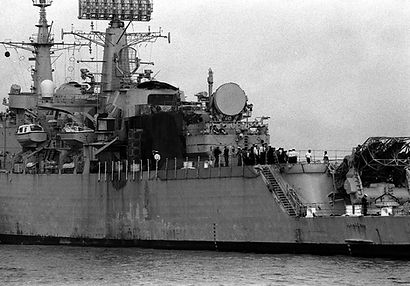
Plate 33. Sea Slug on HMS Glamorgan
Plate 19 from book. This shows HMS Glamorgan’s Sea Slug launcher on the stern and the large Type 901 fire control radar (like a spotlight), which guided the missile in flight. (PA/Alamy Stock Photo)

Plate 34. Sea Slug SAM fired from HMS Devonshire
County-class destroyer firing a Sea Slug missile (likely in the late 1960s). Photographer not reported, Royal Navy.

Plate 35. Sea Slug SAM, County-class destroyers
A Sea Slug Mk.1 missile during trials in Australia in 1959. It had been fired at an unmanned Gloster Meteor drone aircraft (painted white with red nose, engines and upper outer wing panels). The Sea Slug’s smoky approach and the explosion of its 91kg (200lb) warhead can be seen in the left panel. The detonation seriously damaged the aircraft (middle panel), leading to it crashing (right panel). The picture from Alamy was colorised using Photoshop by MR Ibbotson. Chronicle / Alamy Stock Photo.

Plate 36. Westinghouse AN/TPS-43F 3D radar
This radar was used to track British Harriers and ships. To protect it from attacks, it was disguised with corrigated iron to look like a civilian structure. On 31 May it survived near misses (with some damage) from two AGM-45 Shrike anti-radiation missiles fired by an RAF Vulcan (XM597). It survived the war and was captured by the British. Public domain under fair use.

Plate 37. Skyguard radar
Argentine GADA 601 (Grupo de Artillería de Defensa Aérea 601) anti-aircraft Skyguard fire-control radar. This gave radar guidance for AAA guns. The pictured system was hit by AGM-45 Shrikes on 3 June, fired by Vulcan XM597. Four of the radar crew were killed. Image Public Domain. Obtained from 44 Sqn newsletter, which published an extract from an article by Miguel Angel Siva. The images of the crew have been removed from the lower half of the picture.

Plate 38. 5-inch guns, as on ARA Belgrano
I couldn't find a colour picture of Belgrano's secondary armament. She used the US 5"/25 (127mm) DP (dual-purpose) guns, as shown here on USS New Mexico (BB-44) in June 1944. Belgrano had four single mounts per side (8 in total). She had 23 large guns in total, all larger than the British 4.5" guns. Public Domain.

Plate 39. 5-inch guns on sister ship, USS Philadelphia
5"/25 guns on Belgrano's sister ship USS Philadelphia. This shows two of the three open sponsons that were located on each side. Public Domain.

Plate 40. USS Galveston firing its 6"/47 guns
The 6"/47 guns on ARA Belgrano were very powerful and accurate. Here are the guns on the follow-on Cleveland-class ship, USS Galveston (CLG 93), firing at targets in Vietnam in 1965. Public Domain.

Plate 41. Super firing 6-inch turret, Brooklyn-class
Number 2 turret on USS Savannah (CL-42) in 1943. She was from the same Brooklyn-class as ARA General Belgrano (ex-USS Phoenix). The 6"/47 Mark 16 guns are pointing starboard. Belgrano had 15 of these radar guided guns in five turrets. These guns out-ranged the British 4.5" guns. Public Domain.

Plate 42. ARA General Belgrano, 1 May 1982
One of the last pictures taken of Belgrano on May 1, 1982, from the oil tanker Puerto Rosales. Labels show the Seacat launcher, the forward two 5-inch guns on the starboard side and the super-firing 6-inch gun turret. Public Domain.