
BRITISH AIRCRAFT

Plate 1. Short Belfast C.1
Heavy lift transport used to carry large items from UK to Ascension during the Falklands War. Photographer MR Ibbotson, Cosford RAF Museum, 2025.

Plate 3. San Carlos Forward Operating Base (FOB).
Photographed by Alistair Campbell, Royal Marines official photographer.

Plate 5. Hermes' deck 19 May 1982
Three Harrier GR3 aircraft of RAF 1 Sqn parked alongside RN Sea Harriers and a Sea King helicopter. The nearest GR3 carries two 1000 lb laser guided bombs on its wing pylons. Colorised by MR and AM Ibbotson. Wikimedia Commons: Air Historical Branch-RAF/MOD, Open Government Licence version 1.0.

Plate 2. Short Belfast C.1
The giant turboprop engines on the left wing of a Belfast C.1. Photographed by MR Ibbotson, Cosford RAF Museum, 2025.

Plate 4. Sea Harrier FRS1
Sea Harrier at FOB San Carlos, armed with two AIM-9L Sidewinders. Crown Copyright, IWM FKD 2300.

Plate 6. Harrier GR3 (XZ289/07)
Damaged Harrier after crash landing due to ingesting debris at FOB San Carlos (8 June 1982). Pilot: Wing Commander Peter Squire. Ground crews have written ‘SOD OFF ARGIES’ in the grass. Image is attributed to the Ministry of Defence.
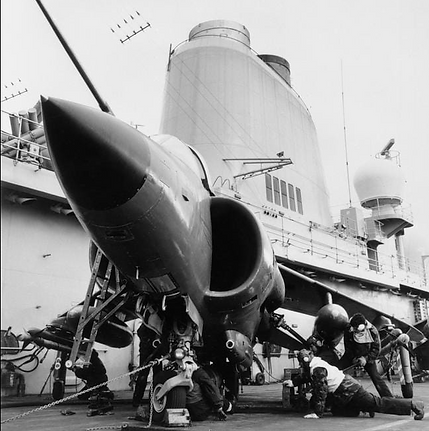
Plate 7. Loading a Sea Harrier FRS1 with a bomb
Armourers loading a 1000lb bomb on to the center line pylon of a Sea Harrier FRS.1 on board HMS Invincible off the Falklands (as reported by IWM).
Starting on 12 May Sea Harriers started harassment operations against Stanley airport. Sea Harriers were armed with VT-fused 1,000 lb bombs for release en route to their CAP station. Bombs were released from medium altitude (15,000-20,000 ft). Thanks to Andy Smith for this information.

Plate 8. Harrier engine
The mighty Pegasus engine that powered the Harrier GR3 and Sea Harrier FRS1. Photographed by MR Ibbotson, Fleet Air Arm Museum, RNAS Yeovilton, 2025.

Plate 9. Harrier GR3 cockpit
Instrument panel in a Harrier GR3. To the left of the yellow chevrons are the switches for gun pod activation. Photo: MR Ibbotson, Farnborough Air Sciences Museum, 2025.

Plate 10. Hercules and Victor
British Hercules C.1 aircraft flew very long supply flights from Ascension to the fleet around the Falklands and back. One on 16 May was ~24 hours in duration and covered 6,300nm or 11,668km. Three Victors refuelled the aircraft using a shallow dive, as shown. Hercules flew the longest duration flights but the Nimrods flew faster and further in a shorter time (13,604km in ~19h). Crown copyright.

Plate 11. Victor K2
Photograph of a Victor K2 at the Yorkshire Air Museum, 2026. The mixture of the dihedral T-tail and anhedral main wings is shown to good effect. Photograph by MR Ibbotson.

Plate 12. Victor K2
One of the best photographs from the war depicts a Victor K2 (possibly flown by Squadron Leader Bob Tuxford) flying at low level with its fuel drogues deployed. Photograph was taken from Ascension Island by RAF photographer Sergeant Brian Lawrence.

Plate 14. RAF VC10
RAF VC10 in the colours used during the war. It is marked with a red cross, revealing its use for transporting wounded. Image contains public sector information licensed under the Open Government Licence v3.0. Photo: Royal Air Force / Ministry of Defence Crown Copyright.
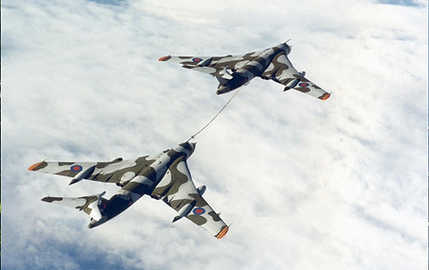
Plate 13. Victors
The Victor is a very photogenic aircraft. In this case, a Victor K2 is transferring fuel to another Victor K2 during a Black Buck mission. This magnificent photograph was taken during the Falklands War by Sgt Brian Lawrence, an RAF photographer.

Plate 15. Nimrods, Harrier GR3s and Victors
Busy day at Wideawake Airfield on Ascension Island during the Falklands War. Two Harrier GR3s are in the foreground, armed with AIM-9s for base defence. Three Nimrods are lined up behind them. Thirteen Victor K2s are furthest from the photographer. IWM collection (FKD 1170), credited to the Fleet Photographic Unit.