
ARGENTINIAN AIRCRAFT

Plate 1
A Beechcraft T-34C-1 Turbo Mentor light attack aircraft on Pebble Island 1982. It is equipped with missile and gun pods, giving it capabilities close to that of an attack helicopter. The name of the photographer is not readily available.

Plate 2
Captured FMA IA 58 Pucará (A-532) at Stanley airport in 1983 (pilot: Hugo Eduardo Algañaraz). Note the yellow panels to indicate that it was a ‘friendly’ aircraft to Argentine AAA gunners. Photograph by Ian Howat.

Plate 3
Argentine SP-2H Neptune. Museo de la Aviación Naval, public domain.

Plate 4
A retired SP-2H Neptune operated by the Royal Australian Air Force. Two of the same aircraft types were used by the Argentinians during the Falklands War. The aircraft is remarkable because its main power comes from two Wright R-3350-32W Turbo Compound radial piston engines, but it obtains boost from two additional Westinghouse J34 turbojet engines. Thus, it has a piston and jet engine visible on the right wing. Photographed by MR Ibbotson at Air Show Down Under, Avalon, Australia, 2015. Note: AI was used to remove identifiable people to the right of the aircraft.

Plate 5
An Australian Navy S-2 Tracker carrier-based patrol aircraft. In Australia, engine start-up is referred to as ‘the sound of round’. Both Argentina and Australia operated Colossus-class aircraft carriers and S-2 Trackers. Australia retired its carrier (HMAS Melbourne) on 30th June 1982, just after the Falklands War. Argentina’s carrier, ARA Veinticinco de Mayo became inoperable in 1990, was decommissioned in 1997 and scrapped in 2000. Photographed by MR Ibbotson, Fleet Air Arm Museum, Nowra, Australia, 2023. Note: AI was used to remove a human from the image.
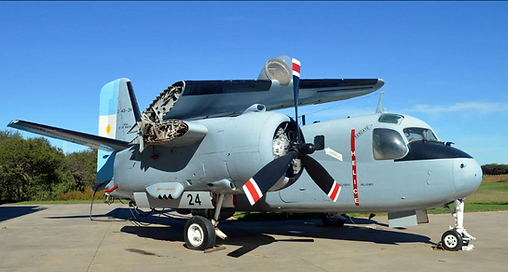
Plate 6
An Argentinian Navy S-2 Tracker carrier-based patrol aircraft. The photographer was likely Sebastián Solís.

Plate 7
An S-2E Tracker landing on ARA Veinticinco de Mayo. Alamy stock photo 2HTCY4A

Plate 8
An S-2E Tracker launching from ARA Veinticinco de Mayo. Public domain. From a post on Mariano Sciaroni's X site.

Plate 9
The wreck of the IAI Dagger flown by Major Piuma on 21 May 1982, serial number C-404. The pilot ejected and survived. The camouflage pattern remained obvious 23 years later when photographed in 2005. Weber Raphael / Alamy Stock Photo.

Plate 10
IAI Dagger, serial number C-403 in October 1981. This aircraft carries small supersonic 500 litre drop tanks. During the war, it carried a trio of giant 1,300 litre drop tanks, which required the aircraft to fly at subsonic speeds. On 21 May, C-403 also carried two 550 lb (250 kg) bombs during a raid, piloted by Captain Donadille. It was shot down by an AIM-9L fired from a Sea Harrier. The pilot survived. Wikimedia Commons: Horacio Claria, Creative Commons Attribution 2.5 Generic License.

Plate 11
Fantastically restored IAI Dagger C-415, displayed as a monument since retirement in 2015. It wears the colour scheme used by Daggers during the war, including the yellow panels for friendly identification. Note the three 1300 litre drop tanks, as used during the war. It is on display at the Museo Nacional de Malvinas, Oliva, Córdoba Province, Argentina. Photographed by Christian A. Amado.

Plate 12
A well preserved IAI Dagger (C-432), carrying three 1300 litre drop tanks. It resides at the Museo Nacional de Aeronáutica, Argentina. Photographed by Jose Luis Ghezzi.

Plate 13
Two A-4 Skyhawks at the Museo Nacional de Aeronáutica, Argentina. Closest is an A-4C from Río Gallegos. They wore an alternating light grey and khaki camouflage scheme. Behind is an A-4B from San Julián. They wore a brown and dark green camouflage scheme. The right hand 20 mm cannon on the A-4C can be seen at the wing root. Its large air-to-air refuelling probe is evident. In the top right of the image is a Canberra B62, B-109. Wikimedia Commons: Aeroprint.com, Creative Commons Attribution-Share Alike 3.0 Unported license.

Plate 14
An Argentine A-4C conducting in-flight refuelling during the war. Note the yellow panels to act as an identification against attacks by friendly AAA. Note the light grey and Khaki camouflage scheme applied to A-4Cs from air base Río Gallegos. Photograph taken by a crew member on the KC-130 Hercules that was supplying the fuel. Public domain.

Plate 15
An Argentine A-4C being loaded for a mission. The Blue patches are for friendly identification. Argentina was desperately short of drop tanks. The colourful tank has been taken from another aircraft. The bomb is a Spanish-designed EXPAL BR-250 general-purpose bomb (250kg). Public domain.

Plate 16
Argentine Navy Dassault-Breguet Super Étendard refuelling. Note the rooster emblem below the cokpit. Public domain. From a post by Mariano Sciaroni.

Plate 17
An Argentine C-130 (TC-68) painted in a commemorative colour scheme, as used during the Falklands War. Note the multiple ejection racks (MERs), carrying six bombs per wing. TC-68 dropped bombs on the US Supertanker Hercules (causing serious damage) and attacked a British tanker (British Wye), without serious damage, during the war. Recognisable faces were blacked out using Photoshop. Photograph by Ruben Pablo Nieves.

Plate 18
Argentine Air Force English Electric Canberra B62 (B-102, ex-RAF WJ713). It carries a rocket pod under the port wing, as often used during the Falklands War. This photograph has been credited to Richard Vandervord.

Plate 19
A Canberra B62 bomber located in Mar del Plata. This aircraft (B-105) has 15 mission markings. Wikimedia Commons: Jorge Souto, Creative Commons Attribution-Share Alike 3.0 Unported license.

Plate 20
B-109 photographed in 1988. Compare colours to Plate 13. Photographed by Carlos Ay or Atilio Baldini.

Plate 21
In the 1960s, the UK offered the Harrier for use on Argentina's aircraft carrier. In 1969, a Harrier sits on the deck of ARA Veinticinco de Mayo. Imagine how different the war would have been if Argentina purchased Harriers! Photographer not reported.

Plate 22
Readily available photograph of Lieutenant Owen Crippa and his ground crew. Crippa was the first pilot to sight the British fleet on 21 May 1982. He flew the MB 339 light attack jet shown. The aircraft is equipped with gun and rocket pods. He fired rockets and bullets at HMS Argonaut, damaging her radar. The photographers name is not readily available.

Plate 23. Learjet-35A
Argentinian air force (FAA) Learjet photographed from a second Learjet in 1982. Grupo 1 Aerofotográfico (1st Air Photographic Group) but also the Escuadrón Fénix (Phoenix Squadron). Image in Public Domain.

Plate 24. Learjet and Dagger
Argentine Learjets escorted fighter bombers, providing navigation and distractions. This Dagger carries two 1,700 ltr drop tanks instead of the normal 3x1,300 tanks. Image in Public Domain.

Plate 25
Two Argentine Agusta A-109As and a UH-1H (hovering) at their Moody Brook base during the Falklands War. The A-109A was used as an attack and escort helicopter. The UH-1H as a transport. Photo by Eduardo Farré (obtained from the archive of Sergio Dalvano). Image in Public Domain.

Plate 26
A Boeing CH-47 Chinook helicopter (AE-520) operated by the Argentine Army (Ejército) during the Falklands War. It is with a second Chinook at Stanley airport (known by Argentina as Base Aérea Militar Malvinas). The photo shows the apron and taxiway at Stanley airport (runway to right). Public Domain.

Plate 27. Aérospatiale Alouette III on Veinticinco de Mayo
Utility helicopters used by the Argentine Navy. One sank on ARA General Belgrano. Image in Public Domain.

Plate 28
Argentine Puma on the Falkland Islands. Photograph by Eduardo A. Rotondo.

Plate 29. EMB-111 and S-2
Argentine Naval Aviation Embraer EMB-111 maritime patrol aircraft, with Grumman S-2 Trackers behind. They are at the Río Gallegos Naval Air Station during the Falklands War. Obtained from Brazil and used on reconnaissance missions after the SP-2 Neptunes were retired. Public domain.