BRITISH SHIPS

Plate 1. MV Atlantic Conveyor
Atlantic Conveyor with a Sea Harrier hovering over her landing pad in Plymouth Sound. The Harrier pilot was likely Lt Cdr Tim Gedge. The photograph was taken by Tony Carney of the Ajax News & Feature Service.

Plate 2. SS Atlantic Conveyor
View from SS Atlantic Conveyor’s bridge, showing the Harriers in protective bags. The aircraft were partially protected by containers stacked along the side of the deck. The Harrier pad is clearly evident towards the bow. It is not clear which crew member took the photograph.

Plate 3. SS Atlantic Causeway
Photograph taken from SS Atlantic Causeway’s bridge (sister of Atlantic Conveyor), showing a County-class destroyer ahead. Note the terrible sea state. It is not clear which crew member took the photograph.
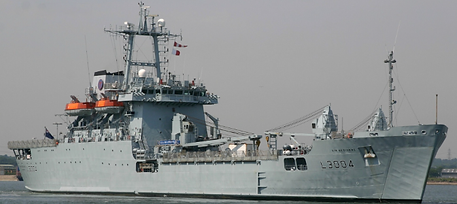
Plate 4. RFA Sir Bedivere (L3004)
She was a Landing Ship Logistics (LSL) that had a major role in the landings on 21 May. Sister ship to Sir Galahad. Photographer not listed, Crown Copyright.

Plate 5. HMHS Uganda (requisitioned cruise liner)
The hospital ship, SS Uganda, labelled HM Hospital Ship (HMHS) during the war. Crown copyright.

Plate 6. HMS Herald (H138) hospital ship
A Hecla-class hospital ship (H138), revealing its small size. The helicopter is a Wasp (9m length). They regularly sailed to Montevideo to deliver wounded, who were then flown home. Crown copyright.

Plate 7. Fort Rosalie-class ships, RFA Fort Austin (A386) and Fort Grange (A385)
Critical British dry stores replenishment ships (AEFS—Auxiliary Equipment Fleet Ships). They were both new during the Falklands War, commissioned in 1978-1979. Photographer not listed, Ministry of Defence.

Plate 8. Tide-class, RFA Tidepool (A76)
Replenishment oiler of the Royal Fleet Auxiliary. She had a very busy war, refuelling ships. Photographed by Ken Griffiths, released to Public Domain.

Plate 9. RFA Stromness (A344)
She was a supply and troop transport. She was present for the landings on 21 May. Photograph by Raymond L. Blazevic (1978), Key West, Florida. Part of the Florida Keys Public Library collection and free of known copyright.

Plate 10. Tugs and St. Helena
Stamps produced for the island of Tristan da Cunha. They show some of the famous support ships. From: https://www.tristandc.com/po/stamps202207.php

Plate 11. HMS Junella (requisitioned trawler)
Junella in very rough weather. She was converted from a trawler into a mine sweeper (MCMV). Photographer not listed by DoD. On one site, Robert Ellis is listed. Crown Copyright, open access for educational purposes.

Plate 12. QE2 amd Paras, South Georgia
Members of the British Parachute Regiment on an MCMV (converted trawler, used for mine sweeping), after transferring from QE2. The QE2 is top left with another MCMV alongside. The MCMVs transferred the Paras to the Falkland Islands. Photograph by Paul R. G. Haley (MOD press photographer, Soldier Magazine).

Plate 13. MV Norland (requisitioned North Sea ferry)
Norland had an essential role in ferrying troops to the Falklands. It travelled into San Carlos in the first waves and was in very serious danger. Note the helipad installed on the top deck has a Sea King on it. Crown copyright IWM (FKD 41).

Plate 14. MV Elk alongside HMS Fearless
Elk was a requisitioned Roll-on/Roll-off car ferry that proved to be an excellent transport ship during the war. At one stage, she carried 2,000 tonnes of high explosive into San Carlos Water! Photograph by Rick Toyer (RN).
Crown copyright IWM FKD 190.