POST WAR

Plate 1. Phantom FGR2
After the war, the RAF flew Phantoms into Stanley airport for air defence. They operated from 1982 to 1992. One crashed on the Falklands in 1983, along with a Harrier GR3. MR Ibbotson, Hendon RAF Museum, 2025.

Plate 2. Phantom FGR2s over the Falklands
An RAF F-4M Phantom FGR2, registration XV461 'Charity', of No. 1435 Flight RAF, with another to its left, June 1991. No. 1435 Flight uses the Maltese cross in its badge to mark its service in Malta during WW2. wiltshirespotter, CC BY-SA 2.0 <https://creativecommons.org/licenses/by-sa/2.0>, via Wikimedia Commons
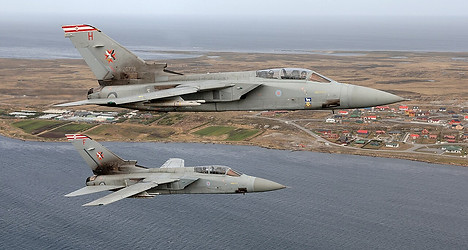
Plate 3. Tornado F3
Two RAF Panavia Tornado F3s from No. 1435 Flight RAF, based at Mount Pleasant Airfield over the Falkland Islands. Operated from 1992 to 2009. Photo by Cpl Darren Smith RAF/MOD, OGL v1.0OGL v1.0, via Wikimedia Commons

Plate 4. RAF Typhoon FGR4 (Tranche 1 but upgraded to multi-purpose. To be replaced by Tranche 2 in late 2027)
Typhoon 'F' armed for the air-to-air quick reaction alert (QRA) role with four AIM-120 AMRAAM missiles from No. 1435 Flight RAF. They have guarded the skies since 2009. The Tranche 2 update will include Meteor long-range (200km) missiles, with a 60km no-escape zone. Photographer: Cpl Rachel Malthouse/
MOD, OGL 2 <http://www.nationalarchives.gov.uk/doc/
open-government-licence/version/2>, via Wikimedia Commons

Plate 5. Sky Sabre (since October 2021)
Left to right: Radar Targeting System Vehicle with the 'Giraffe' Radar deployed, Command and Control Vehicle and the Missile Launcher Vehicle housing the CAMM (Common Anti-Air Modular Missiles). The system can engage multiple targets simultaneously and can take out aircraft, drones and laser guided bombs at 120km range using CAMM, travelling at over 3,700km/h.
Ministry of Defence, OGL v1.0OGL v1.0, via Wikimedia Commons

Plate 6. Type 101 Commander SL radar inside dome on Cyprus (on Falklands since 1998)
I couldn't get a copyright free image of the mobile radar system, so here is the system under a dome on Cyprus. The UK Ministry of Defence (MoD) operates three Type 101 Commander SL mobile radars for long-range air surveillance on the Falkland Islands. Each has a range of 470km for high altitude targets. Photo: Cpl Richard Thomas/MOD, OGL v1.0OGL v1.0, via Wikimedia Commons

Plate 7. Mount Pleasant Air Base in 2026
Screenshot of a Google map of Mount Pleasant showing runway 10/28 (2590m) and 05/23 (1525m). This air base was built after the war and provides living quarters for the garrison, plus runway facilities for Typhoon fighters.

Plate 8. Stanley Airport in 2026
Screenshot of a Google map of Stanley airport, showing runways 09/27 (918m) and 18/36 (338m). The runway facilities were updated after the war. Typhoon can operate from a 700m runway.

Plate 9. RAF Atlas C1 over Bristol (in Falklands since 2018)
An Atlas C1 has been based at Mount Pleasant since March 27, 2018. It conducts tactical airlift, maritime reconnaissance, search and rescue, and humanitarian assistance.
Photographer: Cpl Paul Oldfield. MoD/Crown Copyright (2015), OGL v1.0OGL v1.0, via Wikimedia Commons

Plate 10. RAF Voyager KC3 in the Falklands (since 2014)
RAF Airbus A330 MRTT, known in RAF service as Voyager KC3 (military registration ZZ337) multi-role tanker transport (MRTT) aircraft is parked on the flightline at Mount Pleasant Airfield in the Falkland Islands.
Photographer: Cpl Ashley Keates (RAF), OGL 2 <http://www.nationalarchives.gov.uk/doc/open-government-licence/version/2>, via Wikimedia Commons